

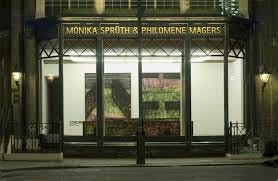
I want to be loved by beautiful people. Be in beautiful places. Laugh at beautiful jokes. And in 2018 I was stood in one of Berkley Square’s side streets. Sexy Fish around the corner. Beneath the glow of Sprüth Magers, some blue-chip gallery where my girlfriend of the time was interning. Outside in the chill, I was lining the length of a Rizla with rolling tobacco, filter already between my lips, when a tall man with a razor cut skull asked me for a light.
His name was Daniel Spivakov. Ukrainian artist. At the time of writing, his German wife is a gallerist in Berlin, and together they are making the waves.
I warmed to him. Wanted him to warm to me. His wife was smoking hot, and I didn’t yet know they were married. My girlfriend not forgotten, I wanted to be loved by both of them, and for a short time I would be. An invite to the French House. Meet ups in Soho and China Street would follow. But that night he asked me a question.
“What do you look for in art?”
And fuck me he hadn’t said it offhand. This was a line he was used to spilling. Waving long fingers and glancing to the side as he said it.
I can’t remember how I responded. Most likely something about feelings or emotion. I was still to pen my manifesto, to state clear my aims and intentions as a writer. The granular building blocks of a philosophy I would cling to at times of need were only then forming. But whatever I had said he had nodded vigorously.
“I look for the light,” he returned.
The fucking light?
All this grand posturing for a line that could be dropped by a shepherd on crutches making sure of a flock’s welfare. The. Fucking. Light?
So I pushed him, though not too hard. I wanted him to love me. But I asked him what he meant, assuming that this kid who was studying at Central Saint Martins would be used to explaining his stance. But he couldn’t. He waved his hand a little more, spoke more of light, about the point at which a canvas is struck and how his eye might be drawn along certain strokes, across colours, down shadows.
Was it the chatter of a bloke with high ambitions? Absolutely. Reflecting now, many years later, do I think he was wrong? No. Wrong perhaps to bring it up with a guy on a come down and a pining for a pint. But I do not think he was wrong in what he said.
“The light.”
I am closer to that now. It is light that appeals to me, too. His inarticulation of what light consists of was a product of the inadequacy of language to express what we feel in our bones. You tell both your mother and your lover that you love them, vary it slightly with a well-placed ‘so much’ to emphasise this feeling, but the expression comes no way close to capturing the throbbing of hearts and desires and appreciation you have.
And love is a trite example. But it applies elsewhere, too. How do we capture the exquisite pleasure of a post-long haul flight cigarette in the cold gusts of Heathrow’s pedestrian concourse? Or the blissful moment of waking, bone-weary, but refreshed, the morning after a punishing long run around the lakes of Milton Keynes?
I watched a YouTube video recently in which Robert Macfarlane was being interviewed by David Perell, and he, a celebrated writer and wordsmith, spoke of the impossibility of precisely capturing and conveying the beauty of nature in words. It cannot be done. That sun setting beyond the Agadir bay with its hues of orange and red splashing rough in the glass veined blue of the salted caramel sea will never be described to the point where you will see what I saw. So, what do we do?
Macfarlane suggests that we coax the mind of our audience to imagine it for themselves. But how to do that? There is a piece in Ted Hughes’ book Poetry in the Making where he speaks on this:
The art of choosing details… is not an easy one… you do not make things any better when you try to fit the picture grain by grain into the reader’s imagination… (but) a comparison is like a little puzzle. When I say “His hair was like a rough coconut’s” – you say to yourself, “How can it be? And this rouses your imagination.
Ocean Vuong teaches something similar to his students at NYU. He explains that mimicry does not capture the reader’s attention. He provides the line ‘A red evening sunset along the hills’ as a useful descriptor. But the line that appears in Isaac Babel’s Red Cavalry is ‘An orange sun rolls across the sky like a severed head’.
This phrase is new. What does that sun look like? We do not, as readers, have a reference point. We must imagine. Good Lord, we must work!
Is the coaxing of imagination, to create the visual of a sunset, a form of Spivakov’s light?
Increasingly, I think that it is. It is a light in the telling, yet any bookworm can tell you that beautiful language and metaphor is not enough to have them whispering in the witching hour, Just one more chapter.
And because I find the terms a bit dull and restrictive I want to shelve any references to plot, story, and character-driven narrative – for now. Plentiful craft books and chapters exist that will pace you through the differences, step-by-step, typically with Western canonical examples or pieces of literature seemingly selected to highlight how well read the author is. And they undoubtedly are, but it can be fucking tiresome.
Instead, I will use a phrase that on first hearing is a little bit wanky, just like Daniel and his reference to light. That phrase, is engagement.
How do we engage a reader?
How do we prevent a reader from disengaging?
And of the two, perhaps that second question is most important. I want to be loved, but more than that, I do not want to be hated, or to feel inadequate. I want readers like moths, or some lost soul in a Swiss mountain tunnel, to be drawn to the end of my story. To burn the candle to its nub. If someone were to disengage… they’ll never see it.
*
